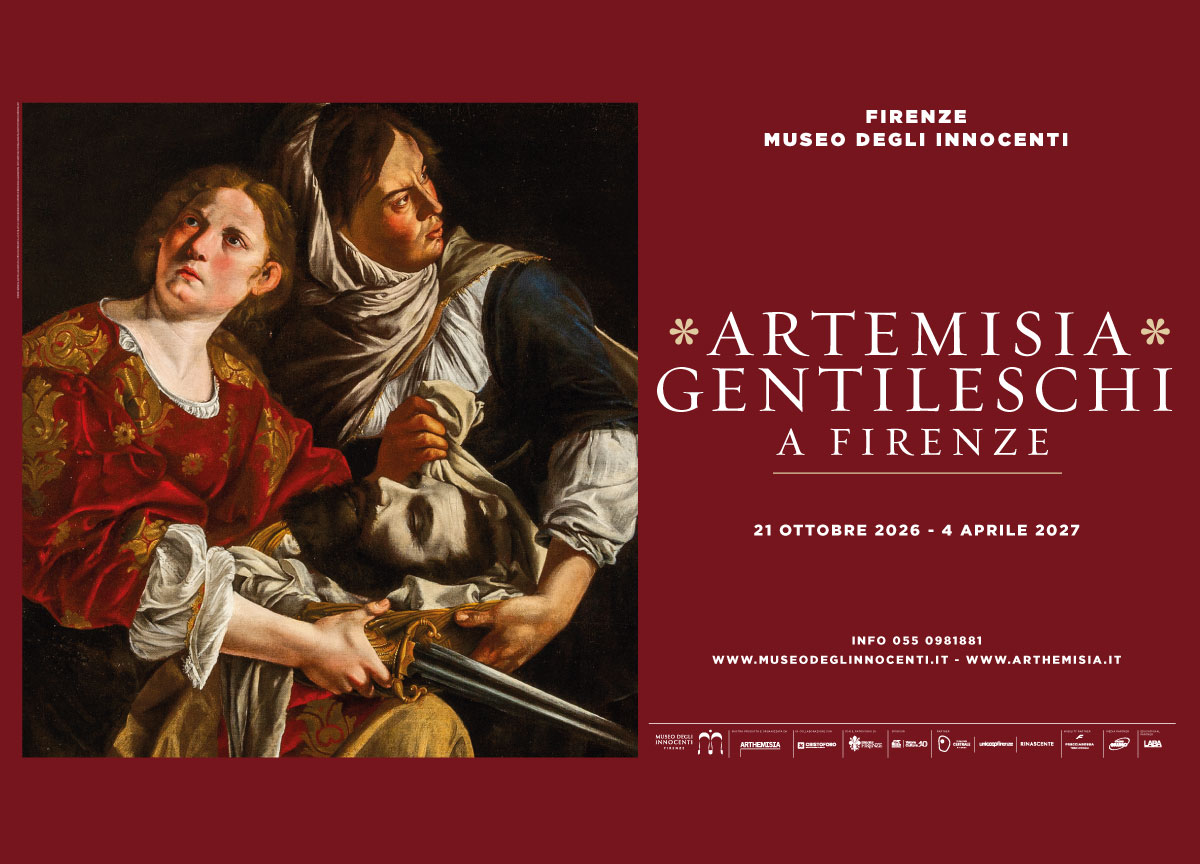
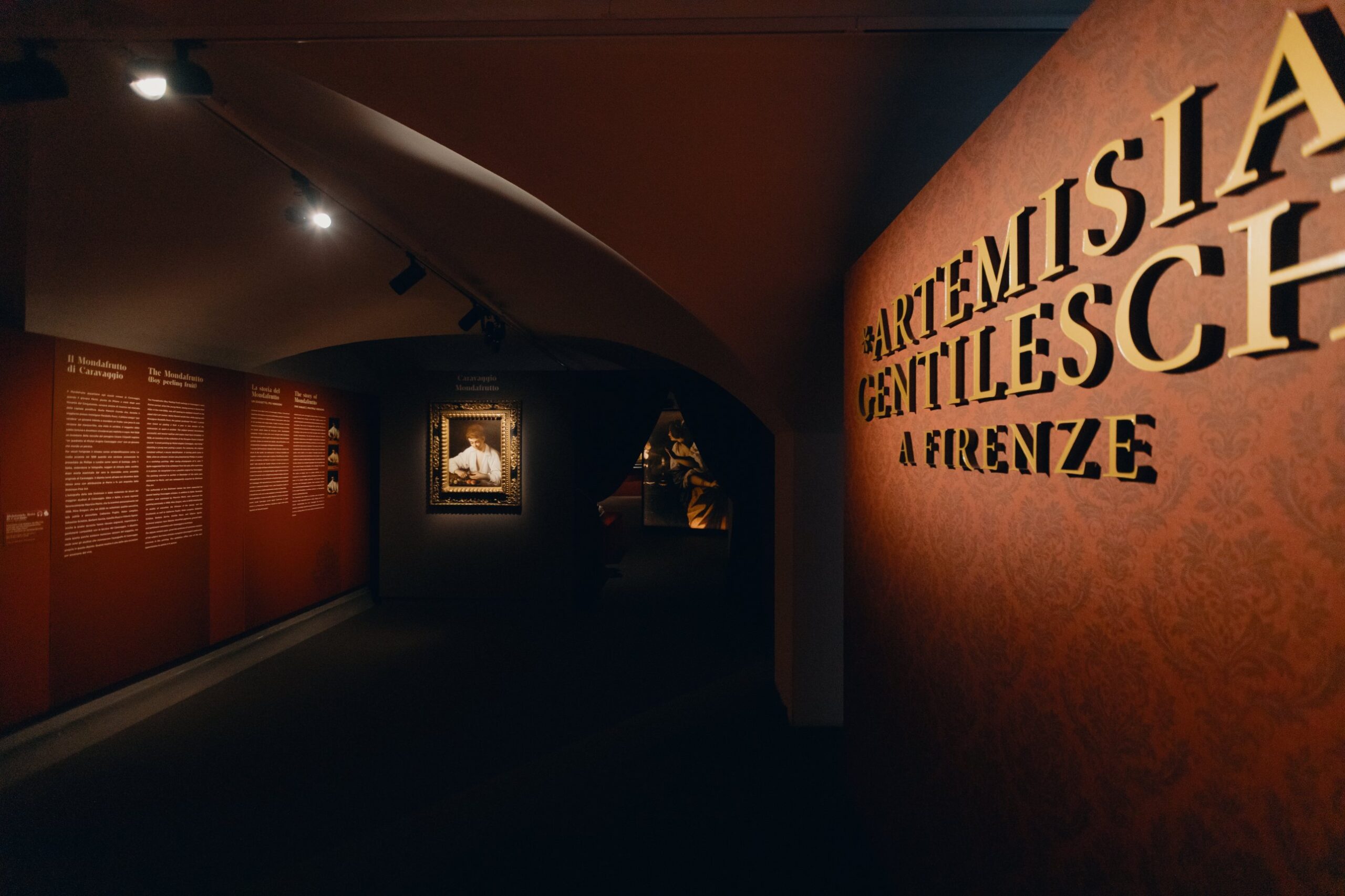
Artemisia Gentileschi in Florence
Artemisia Gentileschi: An Artist Who Worked in Rome, Florence, London, and Naples
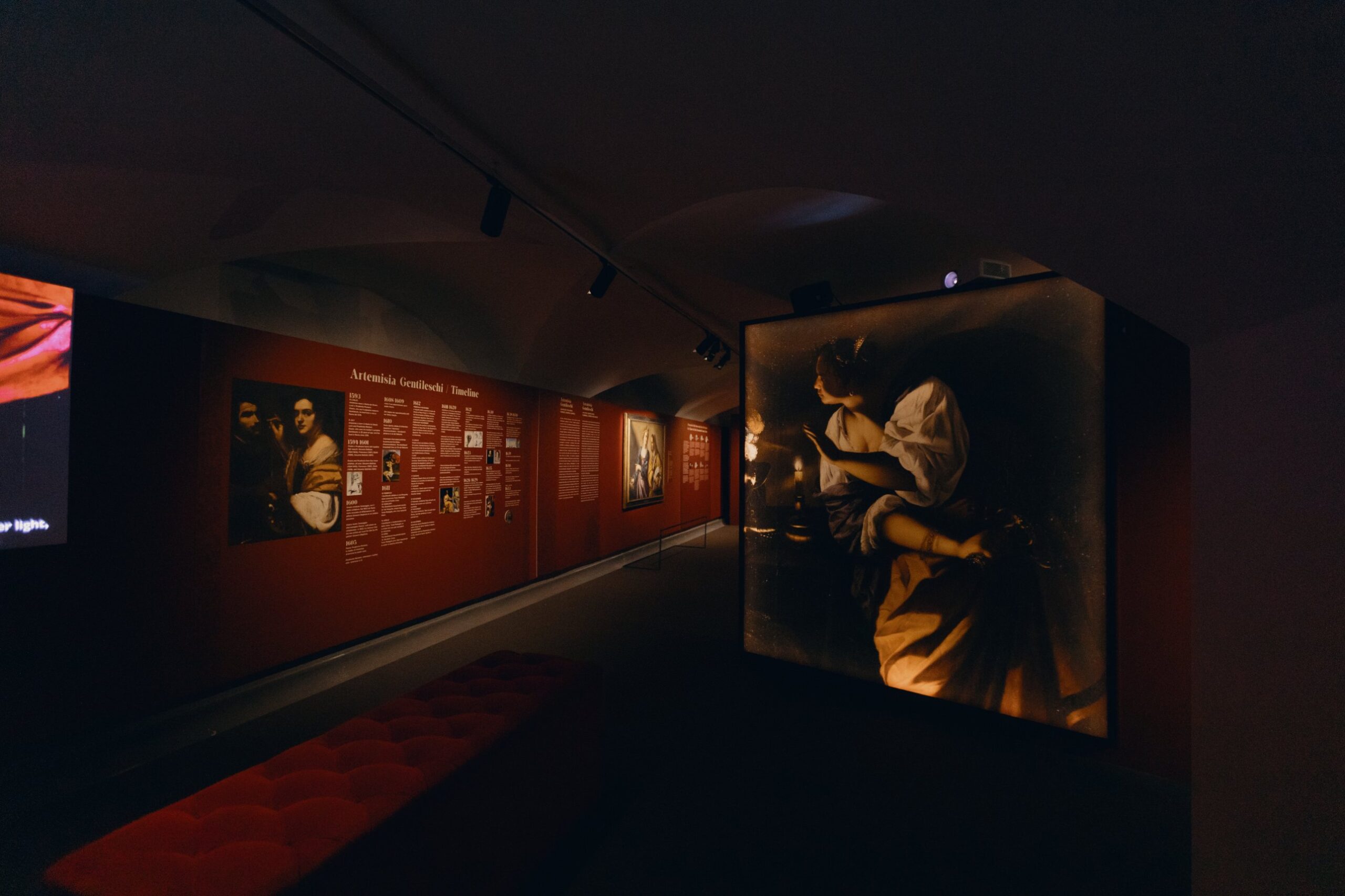
Artemisia Gentileschi navigated early 17th-century Europe, transforming personal experiences, artistic relationships, and courtly encounters into paintings of extraordinary narrative power. The exhibition traces this journey beginning in Rome, where Caravaggio’s naturalism radically transformed the figurative language of art and where Orazio Gentileschi—her father and first teacher—encountered that revolution of light, truth, and physical presence. Artemisia was trained in this environment, yet she interpreted her father’s painting and Caravaggio’s models in her own way, while observing the complex network of artists and patrons that played a profound role in her early career.
The story then delves into the heart of his life: his complex relationship with Orazio, the trial of Agostino Tassi, and the impact that story had on his public life—without, however, reducing his painting to a mere biographical consequence.
Her move to Florence marked the beginning of a new chapter. There, Artemisia met and associated with the leading figures of the early 17th-century Tuscan art scene, engaging with Jacopo da Empoli, Passignano, Cristofano Allori, Matteo Rosselli, and other masters active within the traditions of naturalism, Caravaggism, and Medici culture, until she established her own distinctive and recognizable style.
The exhibition then traces the artist’s journey beyond Florence, through her time in London and her final years in Naples, highlighting the international scope of her career. Paintings from major Italian museums, works rarely shown to the public, and previously unseen pairings allow us to view Artemisia as an independent—though not isolated—artist within the network of relationships, influences, and exchanges that shaped her development.
The exhibition thus serves as a portrait of an artist and, at the same time, of a generation that—across Rome, Florence, London, and Naples—helped redefine the character of 17th-century painting.
Section 1 – Key Figures in Early 17th-Century Rome
In the early 17th century, Rome was a melting pot where painters, merchants, and collectors participated in a radical transformation of figurative art. No true school emerged around Caravaggio, but rather a network of relationships, friendships, rivalries, and commissions that contributed to the spread of his “naturalistic” style of painting.
It is within this network of painters, patrons, friends, and rivals that the Caravaggist revolution took shape; and it was in this same circle that Orazio Gentileschi trained the very young Artemisia.
Artemisia at her father's workshop
“I have a daughter, along with three other sons, and this daughter—as God has willed—having trained her in the art of painting, has become so skilled in three years that I dare say there is no one like her today, having produced works thus far that perhaps even the leading masters of this profession cannot match in skill.”
With these words of praise, on July 3, 1612, Orazio introduced his daughter Artemisia to the Grand Duchess of Tuscany, Christina of Lorraine. It is not hard to imagine the young woman, then nineteen years old, following her father’s guidance in the homes where the Gentileschi family lived and worked. They moved at least four times: from Via del Babuino (1610) to Via Margutta (1611), then settled for a few months on Via della Croce (1611), and finally ended up in Borgo Santo Spirito (1612). At each address, they lived in a modest apartment, where Orazio always managed to carve out a room for painting: there he taught Artemisia the basics of the craft, from mixing pigments to applying paint to the canvas, from handling light to creating soft drapery.
Artemisia also became Orazio’s favorite model. In one painting, we see her as a child playing the spinet while dressed as Saint Cecilia: she learns very quickly and captures every nuance of her father’s craft in his Madonnas and Judiths. Becoming an artist in a family where her father was an important painter meant balancing a context full of influences with the search for a personal artistic voice.
Agostino Tassi, Master of Perspective
Agostino Tassi, born in Perugia in 1578, was a specialist in landscape painting and perspective decoration in Rome during the early decades of the 17th century. His fame is largely linked to the legal case in which he was accused of raping Artemisia. No consideration of the quality of his painting can mitigate the gravity of the violence committed against Artemisia, an act that must be condemned without any ambiguity.
A friend of her father’s, Agostino had been invited to give Artemisia lessons in perspective. During those years, his painting stood out in the Roman art scene for its subjects depicting illusionistic spaces, seascapes, harbors, ruins, and fantastical architecture. Trained in both Tuscany and Rome, Tassi made a name for himself above all as a master of “quadratura”: painted architectural illusions that expand walls and ceilings, transforming real interiors into scenes opening onto loggias, skies, and landscapes. Despite his constant offenses, accusations, and trials, his skill in perspective earned him prestigious commissions and led him to work for important families and construction sites—first in Livorno, where he frescoed numerous palaces that no longer exist, and then in Rome, where he was one of the leading papal painters. In his landscapes, often animated by small figures, natural elements blend with a strong theatrical sensibility: coastlines, harbors, and storms become luminous backdrops, constructed through depth, reflections, and atmospheric variations. Tassi’s personality was also marked by a recurring run-in with the law. When he arrived in Rome in the summer of 1610, he already had a history of legal troubles: he himself would recall having been investigated and tried in Livorno. In Rome, he was subsequently imprisoned several times, in Borgo and Tor di Nona, and implicated in allegations that included an affair with his sister-in-law Costanza. His position, however, was bolstered by a network of high-level patrons: in one of his statements, Tassi recounts having been released “by order of Our Lord,” that is, the pope.
The Casino delle Muse in Rome: The Masterpiece by Orazio and Agostino
The Casino delle Muse, now part of Palazzo Pallavicini Rospigliosi on the Quirinal Hill, was built in the early 17th century as a pavilion for music and performances at the court of Cardinal Scipione Borghese. In 1611, the decoration of the ceiling was entrusted to Agostino Tassi and Orazio Gentileschi, who had previously worked together on construction sites at the nearby papal palace. Tassi created the perspective illusion: five arches and five corresponding vaults arranged around a central panel, designed to optically correct the irregularity of the space and offer the viewer a perfect painted architectural composition. Orazio, on the other hand, contributed the figures, brought to life by bold foreshortening and a refined interplay of glances. The result is an extraordinary all-female orchestra. The musicians play the bagpipes, spinet, lute, organ, violin, flute, guitar, mandolin, cello, and harp; others appear to be singing or dancing. Their damask and velvet gowns, jewelry, and brilliant colors stand out against Tassi’s nearly monochromatic architecture, transforming the ceiling into a scene suspended between painting, music, and theater. Among these figures, one in particular has caught the attention of scholars. She neither plays nor sings: she is accompanied by a maid and carries pearls, jewelry, and an elegant silk fan. Her full face and gathered hair evoke a feminine iconography that Orazio uses repeatedly in his works. This has led to the hypothesis—intriguing but not verifiable with certainty—that this young lady might be Artemisia Gentileschi, then eighteen years old. If this identification were correct, the Casino delle Muse would preserve one of the most fascinating images of the young artist on the eve of her full emergence as an artist.
Section Two – Artemisia in Florence: A Painter at the Medici Court
In Florence, Artemisia Gentileschi did more than simply find new patrons: she forged a true professional identity. Her work was organized primarily within the home, which also became her workplace. In the early years, she set up her studio in the home of her father-in-law, Vincenzo Stiattesi, near San Lorenzo. Vincenzo was a fabric merchant, dealing in fabrics as precious as those often worn by the women in her paintings. After his death in 1615, the family moved, and Artemisia continued to work from home—a widespread practice but one that was particularly significant for a female painter who had to balance her artistic production, social relationships, and family life. In Florence, she also became more proficient in reading and writing, essential skills for dealing with clients and intermediaries and managing an increasingly independent career.
Her relationship with the Medici court went beyond commissions. Artemisia entered a world where painting, poetry, music, theater, and science intertwined, and she learned to navigate a network of gentlemen, men of letters, artists, and officials. Michelangelo Buonarroti the Younger served as one of her gateways into this world, while her relationships with figures such as Galileo Galilei attest to the breadth of her social circle. The painter soon realized that success also depended on her ability to cultivate relationships, negotiate compensation, and establish her own public presence.
The Florentine documents also reveal the cost of this lifestyle: moving expenses, loans, debts, and expenditures on furniture, clothing, and jewelry—all linked to the need to maintain a status befitting the social circles she frequented. These were complex years, in which her private life, household finances, and professional activities continually overlapped.
In 1616, she was among the first female painters to be admitted to the Accademia del Disegno in Florence, a prestigious institution that also gave her the opportunity to address the numerous legal cases in which she was involved—primarily regarding debts owed to suppliers—before the Academy’s tribunal.
Florence thus became the place where Artemisia honed not only her artistic style but also the interpersonal skills, self-presentation, and work management abilities that would shape her entire career.
Artemisia and the Painters in Florence: The Tragic Heroines
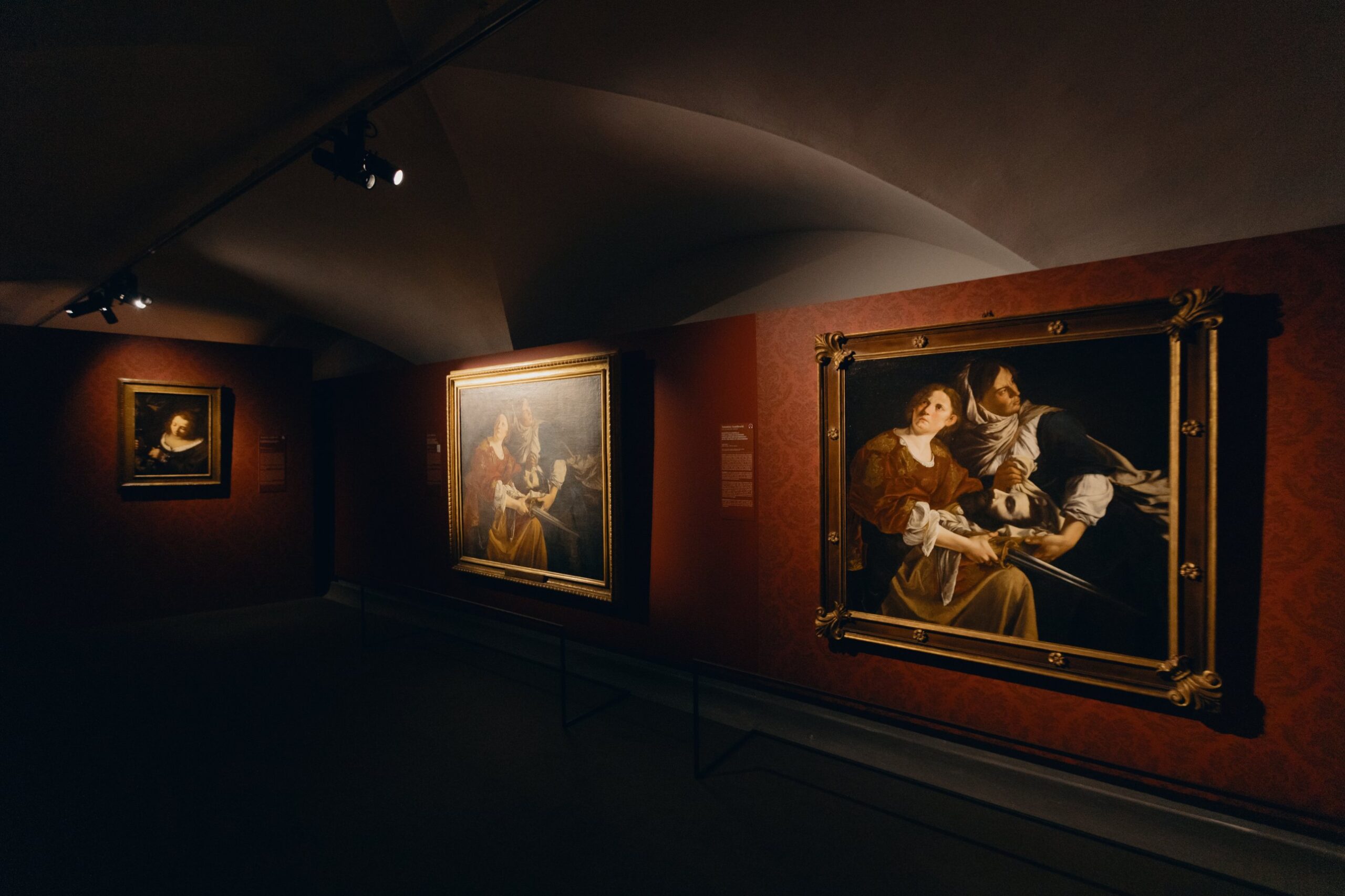
When Artemisia Gentileschi arrived in Florence between late 1612 and early 1613, she found an art scene marked by a strong interest in the heroines of the Bible, history, and ancient mythology. These figures allowed painters to combine narrative tension, sensuality, violence, and virtue, offering patrons images of great dramatic power. The most famous example is that of Judith, the subject of a veritable iconographic boom in seventeenth-century Florence. During the very years of Artemisia’s stay, Cristofano Allori produced a version of her that was destined to become extremely famous: an elegant, motionless Judith holding up the head of Holofernes as an emblem of Virtue triumphing over Vice. The work was replicated and copied numerous times, quickly gaining European renown.
Artemisia approaches the same subject in a radically different way, focusing on the action, the physical exertion, and the collaboration between Judith and her maid. Yet the theme is firmly rooted in Florentine visual culture and will continue to evolve in subsequent generations.
Francesco Furini, Felice Ficherelli, and Giovan Domenico Ferrucci, who were active later in the century, attest to the persistence of this repertoire, in which the female protagonists oscillate between heroism, seduction, sacrifice, and the ability to take action.
Alongside Judith appear Cleopatra, the queen who chooses her own death, and Jael, who kills Sisera to liberate Israel. Ficherelli paints both Jael and Sisera as well as Judith and Holofernes; Ferrucci portrays Cleopatra; Furini revisits female figures drawn from history and myth.
The Florence that welcomes Artemisia thus offers fertile ground for images of women placed at the center of the action, capable of shaping the course of history.
Biblical Stories and Classical Mythology: From Fiction to Reality
In early 17th-century Florence, religious painting and painting inspired by classical mythology shared the same narrative impulse: ancient episodes were transformed into vivid scenes, constructed through gestures, emotions, glances, and a growing attention to the realism of the human form. It was an atmosphere in which the Florentine tradition of drawing opened up to Venetian color, naturalism, and a theatricality capable of making complex stories immediately accessible.
The works brought together in this section showcase the diversity of this artistic exploration. In *The Prayer of Thanks to the Lord* by Tobiolo and Sara, Jacopo da Empoli sets the scene within the intimacy of the bridal chamber: the two young people pray together while, beyond the window, their deliverance from the demon takes place. In *The Finding of Moses*, Matteo Rosselli, on the other hand, transforms the episode from the Book of Exodus into a choral scene, in which the destiny of the future liberator of Israel takes shape through the encounter between the child and the Pharaoh’s daughter. In *The Archangel Raphael Rejects Tobias’s Gifts*, attributed to Vincenzo Dandini, the concluding moment of the biblical narrative becomes an opportunity to depict the relationship between the earthly and divine worlds.
Alongside the Bible, mythology offers artists an equally fertile repertoire. In Passignano’s *Danae* , the ancient myth allows for an exploration of the body’s sensuality and the power of metamorphosis—themes that Florentine figurative art addresses with increasing freedom. The sacred and the profane are therefore not two separate worlds: both offer painters stories of trial, desire, salvation, and transformation, in which the narrative becomes the ideal setting for experimenting with new forms of emotion, light, and human presence, appealing to an audience increasingly sensitive to the power of images.
The Sacred: From Drawing to Flesh
In early 17th-century Florence, the depiction of saints became one of the primary avenues for exploring a relationship with nature. The tradition of drawing was combined with direct observation of the human form, a more incisive use of light, and a focus on the physical presence of the figures. It is within this context that we can compare the *Saint John the Baptist* paintings by Filippo Tarchiani and Carlo Dolci. In the former, set against a wooded landscape, the saint is a young man with a sturdy physique, studied from life: the raking light shapes his flesh, while the lamb, the leather garment, and the cross are rendered with almost tactile precision. Tarchiani thus blends the Florentine naturalism of Jacopo da Empoli with Caravaggesque influences absorbed in Rome, where he had encountered a new way of constructing figures through light and shadow. Dolci begins with a similar attention to the live model but transforms it into a more intimate and refined image: reality is filtered through meticulous and luminous brushwork, which elevates the natural subject to a devotional dimension.
The same dialogue between observation and spirituality runs through the *Saint Jerome* by Jacopo Vignali—Dolci’s own teacher—in which the figure of the hermit is rendered through a tangible presence. In this context, Orazio Gentileschi’s *Saint Jerome in Prayer* serves as an essential precedent. Here, too, the sacred emerges from the depiction of a real man, observed in the solitude of prayer: his face, hands, skin, and clothing are bathed in a light that does not idealize but reveals.
Between Rome and Florence, “painting from life” thus became a shared language, capable of transforming saints and hermits into human figures that felt close to the viewer—and, for this very reason, more persuasive and engaging.
The Magdalene Misunderstanding
Mary Magdalene is one of the most recognizable figures in Christian tradition, but her image also stems from a long history of various characters being conflated with her. In the Gospels, in fact, the sinner who enters the Pharisee’s house, washes Jesus’ feet with her tears, dries them with her hair, and anoints them with perfume is not named. Mary Magdalene, on the other hand, is the disciple present at the foot of the cross and, above all, a witness to the Resurrection: having gone to the tomb, she encounters the risen Christ and announces the news to the apostles. The identification of these figures, to which was added
Mary of Bethany was established in the West by Pope Gregory the Great, who, in a homily from 591, interpreted her as a single person. This gave rise to the image of Mary Magdalene as a repentant sinner, and the jar of ointment became her most common attribute: it refers both to the anointing of Christ and to the spices intended for funeral rites with which the women went to the tomb.
By the 17th century, this iconographic fusion had become firmly established. Painters were thus able to depict Mary Magdalene as a penitent, a convert, a woman in mourning, or a witness to the Resurrection, bringing together sensuality, sorrow, devotion, and redemption in a single image. Her long hair, the vase, the skull, or the book became her instantly recognizable symbols.
Artemisia Gentileschi’s “Magdalenes,” however, introduce a personal touch. Even when depicted in repentance or meditation, they do not appear fragile or overwhelmed by grief: they are women who are present, self-aware, and often monumental. The richness of their garments, the solidity of their bodies, and the intensity of their gestures bring to life proud figures in whom conversion does not erase their identity but seems to strengthen it. Artemisia thus transforms a traditional model into a feminine presence endowed with autonomy and inner strength.
Faces and Portraits
In seventeenth-century Florence, portraiture was one of the genres through which court society constructed and communicated its image. Princes, gentlemen, musicians, and men of letters were depicted not only in their physical features but also through clothing, objects, and postures that signified their rank, profession, and identity. Cristofano Allori’s *Cosimo II de’ Medici* belongs to the official realm of dynastic representation, whereas in Lorenzo Lippi’s *Portrait of Angelo Marzi Medici as Silvio* , the subject almost enters a theatrical scene, accompanied by his dog Melampo. In Volterrano’s *Portrait of a Lute Player *, on the other hand, the musical instrument and the pose transform the effigy into an image that is both individual and evocative, suspended between a portrait and the portrayal of a role.
Against this backdrop, Artemisia Gentileschi’s portraiture introduces a more energetic and immediate presence. The faces stand out with conviction, supported by direct gazes and a strong awareness of their position in space. But it is above all in the clothing that the painter reveals a particular refinement: silks, velvets, lace, jewelry, and accessories are not mere ornaments, but contribute to defining the character and status of the person depicted. In the so-called Portrait of Count Andrea Barbazza, this attention to the face and the texture of the garment creates a figure of great intensity. Even more eloquent is the *Portrait of a Lady with a Fan*, likely a self-portrait: the opulence of the gown and the confidence of the pose transform the female image into a statement of presence. In Artemisia’s portraits, elegance and individuality coincide, and appearance becomes an essential part of identity.
Artemisia at Casa Buonarroti
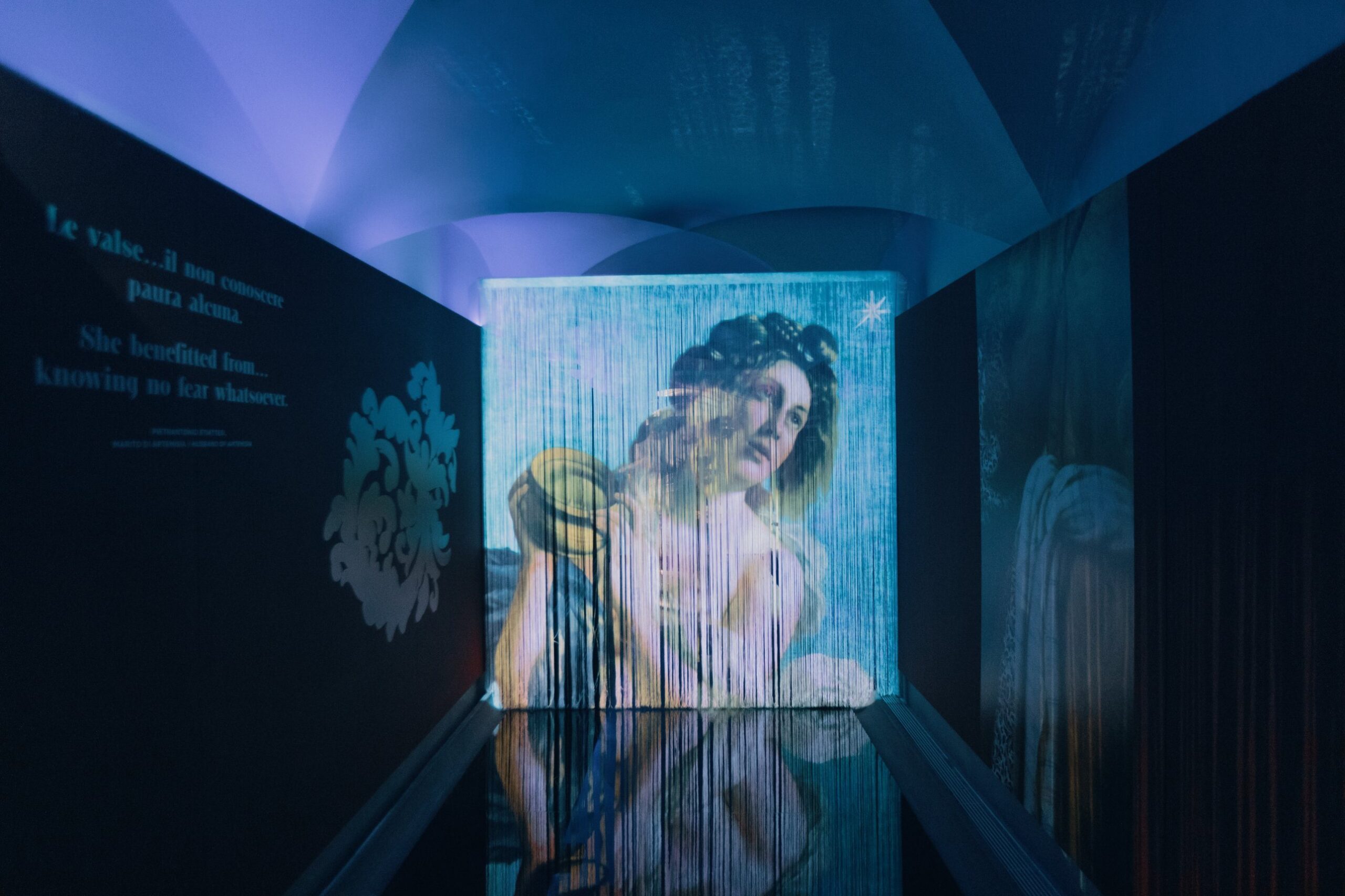
Artemisia Gentileschi’s *Allegory of Inclination* is usually found on the ceiling of one of the halls at Casa Buonarroti in Florence: its inclusion in this exhibition is an exceptional event, made possible by the recent restoration that has restored the painting to its original brilliance. The work, commissioned from Artemisia in 1615 by Michelangelo Buonarroti the Younger, was intended to depict “The Inclination. A young woman of bold spirit, standing with her hands outstretched, holding a compass; a star before her forehead as if to guide her; and two small carts at her feet.”
Although a change of heart led to the removal of the pulleys, the figure perfectly adheres to the commission, emphasizing a “boldness” that has transformed into a sublime sensuality, due to the woman’s naked body (which would be covered by two cloths only in the second half of the 17th century by Volterrano) and the languid expression on her face. The painter worked on it between August 24, 1615, and August 20, 1616, as evidenced by the payments recorded for her in the Buonarroti Archive. In total, she received the substantial sum of 34 gold florins—more than three times the amount paid (10 florins) to the other painters commissioned to paint the Virtues and nearly the same sum (35 florins) received by the painters of the larger murals on the walls. Artemisia was in her second pregnancy while workingon *Inclination* until , on November 18, 1615, she gave birth to her second child, Cristofano, who would die at the age of only five. As has been observed repeatedly in many of her other works, Artemisia included a self-portrait in this painting as well.
“The Inclination” is actuallypart of a much broader program. On the ceiling of the Michelangelo Buonarroti the Younger Gallery, he had brought together a series of personifications intended to celebrate the moral and intellectual qualities of his famous great-uncle: alongside“The Inclination” were “The Ingenuity” by Francesco Bianchi Buonavita,“Honor,” “Moderation,” “Study ,” and “Tolerance.” The canvases, commissioned from different artists but incorporated into the same wooden ceiling, together formed a sort of allegorical portrait of Michelangelo. BianchiBuonavita’s *Ingenuity* , painted between 1615 and 1617, thus belongs to the same period and the same project as Artemisia’s work.
The relationship between the two allegories is particularly significant.
"Inclination" represents the natural predisposition—that irresistible force that, from youth onward, guides an individual toward his or her calling; it is no coincidence that this was a personification almost tailor-made for Michelangelo, as it was absent as a separate entryin CesareRipa’s *Iconologia* at the time the commission was awarded.Ingenuity can be seen as its natural complement: the innate vocation is accompanied by the creative faculty capable of transforming it into invention and work. Together, the two paintings thus recount the very origin of Michelangelo’s genius: first, the inevitable impulse toward art; then, the intelligence that allows him to give it form.
Artemisia: From Florence to Naples
In 1620, Artemisia Gentileschi left Florence. Her years in Tuscany had brought her prestige, connections, and important commissions, but they were also marked by debts, legal disputes, and family difficulties. As is evident from the letters she wrote from Rome to her Florentine lover, Francesco Maria Maringhi, many unresolved issues remained in Florence. She returned to Rome, where she remained for most of the 1620s, by then an established artist sought after by collectors and patrons. Living with her was her daughter Prudenzia, also known as Palmira, the only one of her children to reach adulthood.
In 1630, Artemisia moved to Naples, one of Europe’s major capitals and one of the Mediterranean’s most vibrant artistic centers. There she opened a successful workshop—where Prudenzia also trained—and received commissions from aristocrats, religious orders, and circles connected to the Spanish court. She created major public works, such as the paintings for the cathedral in Pozzuoli, while her name was now known far beyond Italy. Naples became her adopted city and, with a few brief exceptions, the place where she would spend the rest of her life.
Artemisia’s fame even reached England. In 1638, she accepted an invitation from King Charles I and left for London, where she was reunited with her father, Orazio Gentileschi, who had been a court painter for years and was working on the decoration of the Queen’s House in Greenwich. Father and daughter thus returned to working in the same environment after a long separation. Orazio died in 1639; shortly afterward, Artemisia returned to Naples, where she continued her career.
The story continues on the upper floor, in the galleries of the Pinacoteca at the Museo degli Innocenti, where the exhibition features works from her years in London and Naples, tracing Artemisia’s most international and mature phase of her career.
Section 3 – The Final Years Between London and Naples
In the final years of her career, Artemisia Gentileschi seems to have gained a new sense of freedom. The isolated, monumental figures that had characterized many of her early works increasingly give way to complex scenes in which multiple characters interact through gestures, glances, and movements. The painter does not abandon the strength of her protagonists, but individual heroism is no longer the sole focus of the image: what matters now is the narrative.
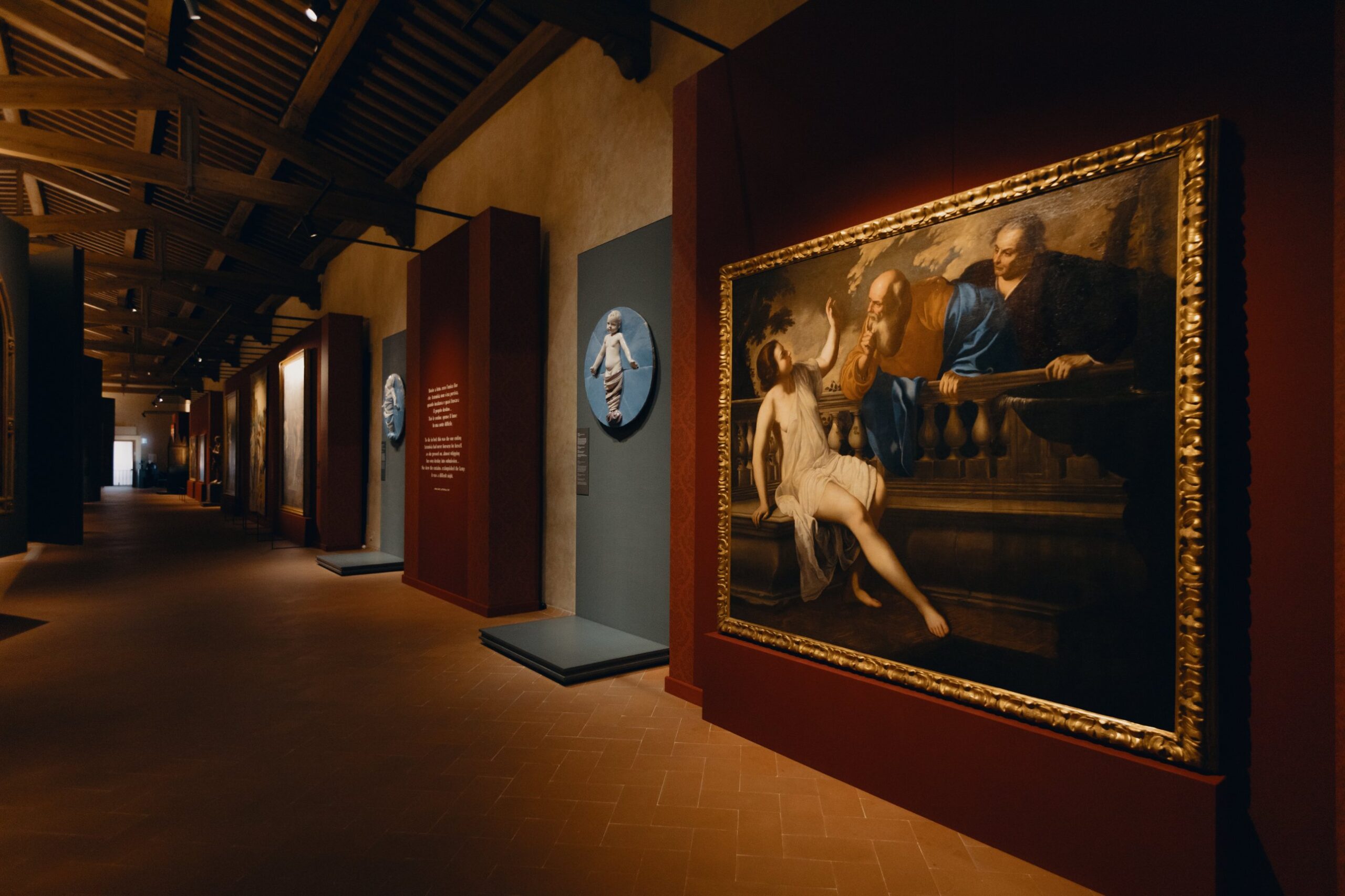
In *Samson and Delilah*, the action arises from the intimate relationship between the two bodies and the psychological tension of the scene; in the large Capodimonte painting *Judith and Her Maidservant with the Head of Holofernes* , however, the murder has already taken place, and the drama continues in the gazes, the silence, and the anticipation. Even in her late work *Susanna and the Elders*, signed and dated 1652 and painted in collaboration with Onofrio Palumbo, Artemisia constructs a complex composition in which the narrative takes shape through the interplay between the figures. Her painting had by now become fully narrative, capable of tackling large formats, prestigious collections, and public commissions. Artemisia worked for private clients, courts, and churches, and even took on altarpieces—a field traditionally reserved for the most established painters. She no longer sought to be considered an exception: she competed on equal footing with her male colleagues, ran a workshop, and collaborated with other artists.
Her long career thus leaves a legacy that extends beyond her individual works. Thanks to Artemisia, a woman can be recognized as a professional, secure major commissions, lead collaborators, and compete in the most prestigious genres. Seventeenth-century painting did not suddenly become an equal world, but her experience helped open up a new space that other female artists could occupy.
https://www.ticket.it/mostre/evento/artemisia-firenze.aspx
https://www.ticket.it/mostre/abbonamento/artemisia-firenze.aspx
Tickets
Exhibition + Museo degli Innocenti
Reservations, made by purchasing tickets in advance, are strongly recommended.
You can also purchase admission tickets on-site; in this case, entry to the exhibition may involve waiting in line to ensure that the safety capacity limits of the exhibition halls are observed.
Full price: € 16.00
Reduced Price: €14.00
Ages 65 and older (with ID), children ages 11 through 17, students up to age 25 (with ID), military personnel, and law enforcement officers; one companion for a person with a disability who requires assistance; journalists with a valid National Press Association card (professionals, trainees, freelance journalists), Arthemisia cardholders, Unicoop Firenze cardholders (tickets available only at the box office) valid every day, holders of Arthemisia tickets for current exhibitions, and holders of the “Mercato Centrale” brochure dedicated to the exhibition (tickets available only at the box office, upon presentation of the brochure)
Rinascente Discount: €15.00
Rinascente cardholders; ticket valid Monday through Friday, excluding holidays; available only at the box office upon presentation of the card
Generali Discount: €14.00
Generali Group employees and agents, Assicurazioni Generali customers holding registered shares, shareholders
Reduced price for college students: €12 .00
Every Monday, except holidays, for all college students, regardless of age
Trenitalia Discount: €12.00
This offer is available to all customers who hold a Frecciarossa, Frecciargento, or Frecciabianca ticket to Florence with a departure date up to 2 (two) days prior to the exhibition visit. The ticket can be purchased exclusively at the exhibition ticket office. Holders of Frecciarossa, Frecciargento, or Frecciabianca train tickets who purchase a ticket at the ticket office with the aforementioned discount must present their train ticket upon entering the exhibition; if they fail to do so, they will be required to pay the full ticket price. Discounts cannot be combined.
This ticket allows you to skip the line
Reduced price for children: € 6.00
Children aged 5 to 11 (not yet 12)
Open Ticket €19.00
This ticket grants admission to the exhibition without the need to reserve a specific date or time slot; you may visit on any day of your choice at the time of your choice.
You do not need to provide advance notice of the date and time of your visit.
Valid from the day after purchase until the end of the exhibition.
Available exclusively on the website www.ticket.it
Group discount: €14 .00
Reservations required; min. 7, max. 20 people; microphone use required
To ensure the smooth scheduling of tours, advance reservations with prepayment are required for groups and schools, whether a guided tour led by museum staff is requested or the group is led by external guides
Reduced rate for schools: €5 .00
Reservations required; maximum 25 people; microphones required for secondary schools
To ensure the smooth scheduling of visits, advance reservations with prepayment are required for groups and schools, whether a guided tour is requested or the group is led by external guides
Free Admission
Children under 5 years of age; pre-registered chaperones or group leaders (1 per group); teachers accompanying school groups (2 per group); ICOM members (the membership card does not grant skip-the-line access; tickets must be picked up at the ticket window upon presentation of the card); visitors with disabilities, upon presentation of the relevant certification; holders of invitation coupons; holders of the Arthemisia VIP Card; journalists with a valid National Press Association card (professionals, trainees, freelance journalists) on assignment, subject to accreditation requested by the editorial staff at press@arthemisia.it; licensed tour guides (upon presentation of their professional license)
booking and advance sale fees
Individuals: €1.50 per person + agency fees
Groups and schools: €1.00 per person
Guided tours of the exhibition for adult groups and school groups
(ticket prices not included; reservations required; headset audio guide required for adults and secondary school groups, included)
Adult groups €120.00
(in a foreign language €140.00)
School groups €90.00
(in a foreign language €110.00)
Audio Guide €3.00
Available for purchase at the exhibition ticket office
Audio System
(Required for adult groups and secondary schools with an outside guide who do not have their own system)
€20.00 per group
Guided tours for individual visitors by appointment:
Check the schedule and purchase tickets in advance on the website www.ticket.it, in the “Tours and Guided Visits” section
Teacher Bonuses and Culture Cards
Purchase exhibition tickets using teacher bonuses and culture cards exclusively on the website www.ticket.it
Every day from 9:30 a.m. to 7:00 p.m.
Last admission: one hour before closing time.
Special openings
Sunday, November 1, 9:30 a.m. – 7:00 p.m.
Tuesday, December 8, 9:30 a.m. – 7:00 p.m.
Thursday, December 24, 9:30 a.m. – 3:00 p.m.
Closed on Friday, December 25
Saturday, December 26, 9:30 a.m. – 7:00 p.m.
Thursday, December 31, 9:30 a.m. – 3:00 p.m.
Friday, January 1, 12:30 p.m. – 7:00 p.m.
Wednesday, January 6, 9:30 a.m. – 7:00 p.m.
Sunday, March 28, 9:30 a.m. – 7:00 p.m.
Monday, March 29, 9:30 a.m. – 7:00 p.m.
Standard rates
You do not need to provide the date and time of your visit in advance.
Valid from the day after purchase until the end of the exhibition.
Available exclusively on the website www.ticket.it
Special rates
Culture Card (Bologna Welcome Foundation)
Unicoop Florence
Coupon Mercato Centrale
Friends Card La Rinascente
I Gigli Pass
Special rates
Exhibitions and exhibition spaces
Ticketing and reservations
You may also be interested in.